
Australia: Resilience by design, not by chance



In this series, we take a closer look at how key countries and territories ranked in the 2026 FM Resilience Index. The FM Resilience Index is a tool developed to help understand a country’s vulnerability to disruptive events and its ability to recover swiftly, as well as which risks are manageable. Now in its 13th year, the index provides a comprehensive risk assessment of 130 countries and territories.
What’s working well
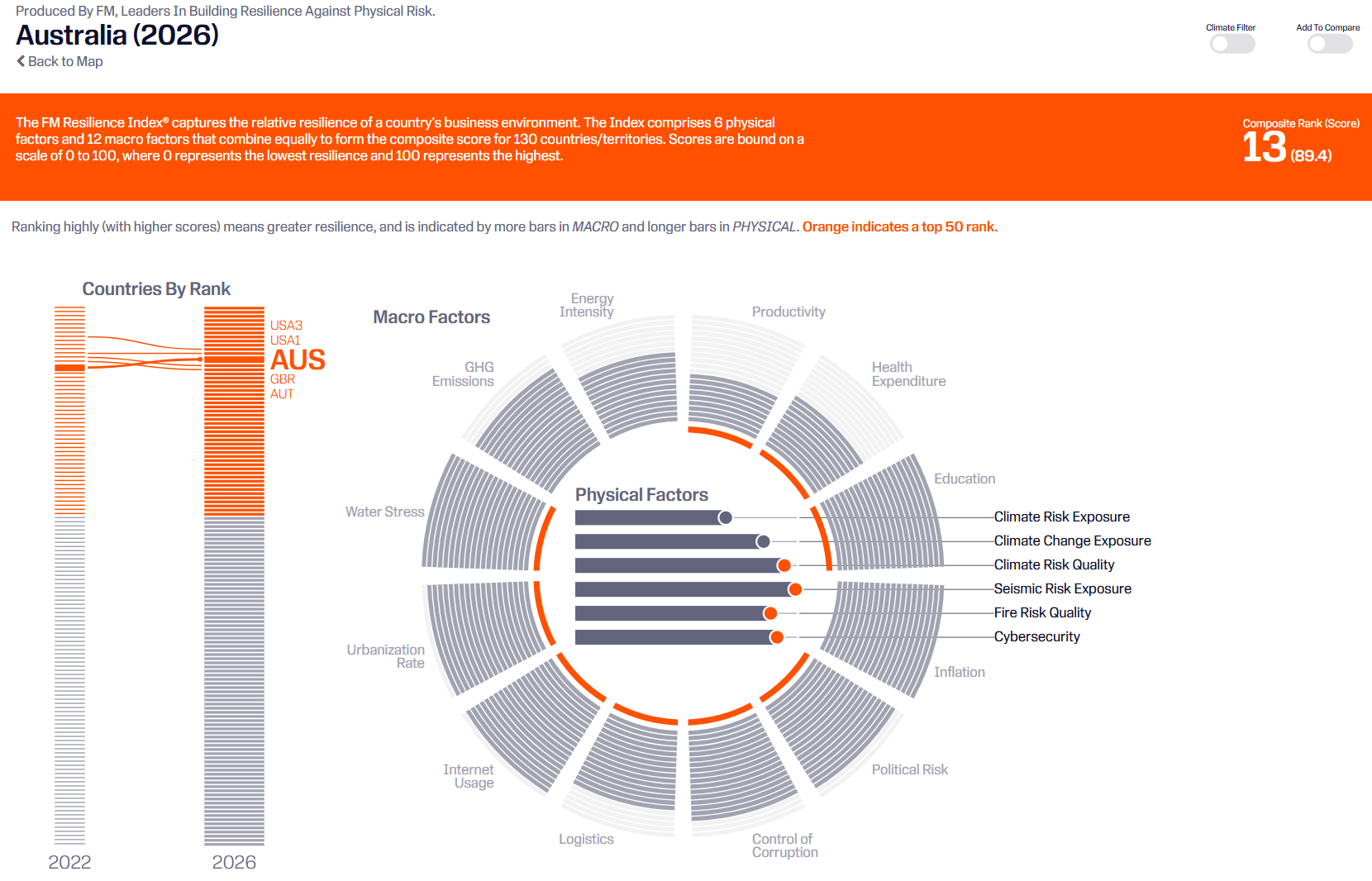
- A top‑tier resilience address: Australia finished No. 13 out of 130 in the 2026 FM Resilience Index, with an overall score of 89.37.
- A physical-risk profile that reads well in the boardroom: Australia’s physical score (92.39) outpaces its macro score (86.05), underpinned by strong results in water stress (No. 34), seismic risk exposure (No. 32) and climate risk quality (No. 13).
- The quiet power of capability: Australia posts a perfect education score (100, No. 1 globally) with strong digital indicators such as internet usage (No. 13) and a top 50 for cybersecurity.
Works in progress
- Climate exposure is the big asterisk: Australia’s climate risk exposure sits at a low 68.04, with a rank of No. 103.
- Productivity remains the stubborn drag: Australia’s productivity score is 44.89 (No. 22), the weakest of its macro drivers in the 2026 data set.
- Energy intensity needs attention: Australia’s energy intensity score of 64.18 (No. 103) signals a middling position for an economy aiming to host more power‑dense, digital infrastructure.
Australia likes to sell itself with postcards. A flat white on a sun‑splashed beach. A ferry cutting across Sydney Harbour, past the Opera House. Centre Court at Rod Laver Arena. Sunrise over the Great Barrier Reef and sunset behind Uluru.
But looking past these scenes, executives are looking for less glamourous boasts, like continuity. They want to know whether a country can keep the lights on, keep people safe, keep goods moving, keep inflation from chewing up margins and keep the internet humming when the weather, markets or geopolitics get messy. That is where the 2026 FM Resilience Index becomes essential reading for any business leader with operations here, or ambitions to build them. This annual survey, now in its 13th year, evaluates 18 categories of risk, providing a detailed snapshot of how nations are equipped to handle various challenges.
The headline is pleasingly simple. Australia ranks No. 13 in the 2026 FM Resilience Index, just ahead of the United Kindgdom, and unchanged from last year. It is a familiar position, and that in itself is a feature. The FM Resilience Index is designed to balance sensitivity with stability, favouring structural change over short‑term volatility. For boards, that steadiness is likely not boring, but investable.
Still, No. 13 is also a reminder that Australia sits just outside the global top 10 club in a year where Europe dominates the upper reaches. That makes for a useful question: what exactly keeps Australia on the doorstep looking in?
The good news first
Start with the physical profile. Australia’s physical score (92.39) is stronger than its macro score (86.05). This is where the country earns its reputation as a dependable place to site high‑value assets, from advanced manufacturing to logistics nodes, from life sciences to offices full of people whose laptops need to work every day.
The numbers tell a story of relative physical safety in the FM Resilience Index’s framework. Water stress (No. 34), and seismic risk exposure (No. 32) score well -- the kind of metrics that make risk managers relax their shoulders, slightly. Climate risk quality (No. 13) is also high, suggesting strong capability in how risk is managed, assessed and engineered around. For a country that loves telling newcomers that “everything here wants to kill you”, Australia’s measured physical resilience is a useful counterpoint.
Then there is the infrastructure of a modern economy. Internet usage (No. 13) and cybersecurity (No. 47) are strong, which matters when so much operational risk now travels through networks and supply‑chain systems rather than storm drains. Australia still fares poorly for fixed broadband due to a "multi-technology mix" National Broadband Network (NBN) rollout that relied heavily on aging copper, resulting in lower speeds and higher congestion. The great relief is that this is tempered by much higher speeds for mobile internet. In the FM Resilience Index’s global framing, cybersecurity gaps are widening in many places; being on the right side of that ledger is a quiet advantage.
And the country’s capability stack holds. Education posts a perfect 100 in 2026, and Australians have come to expect no less. Along with a progressive national curriculum to Year 12, there are top tier universities, vigorous vocational training programs, world-class research facilities, strong protections for international students and low interest federal government loans, known simply as HECS.
“That makes for a useful question: what exactly keeps Australia on the doorstep looking in?”
The “yeah, but” section begins with climate
Australia’s risk conversation always circles back to weather. It has to. From summer bushfire seasons that turn the sky sepia to east coast lows that dump months of rain in days, the extremes have become part of boardrooms and breakfast radio alike -- and let’s not forget that the costliest natural disaster in Australian insurance history was the 1999 Sydney hailstorm. The 2026 FM Resilience Index does not reduce that reality to a single headline, but it does flag the pressure point with clarity. Climate risk exposure lands at 68.04, or a global rank of 103.
What makes this especially relevant for executives is the “awareness gap” FM highlights: decision‑makers often underestimate climate exposure, and the gap is widest in China and India, followed by Australia, Canada and the UK. In practical terms, that is not a moral failing. It is a forecasting problem. If the risk is not fully understood, it is hard to price, insure, engineer against or explain to investors.
The good news is that Australia’s strong climate risk quality score suggests the capacity to manage this exposure is present. The more uncomfortable truth is that capacity needs to be used with discipline. Climate exposure is not a once‑a‑year slide. It is a continuous input into where you build, how you build, and what you do when the BOM radar turns red and black.
Productivity and energy: the unglamorous constraints
Australia’s other clear weak spot in the 2026 data is productivity, with a score of 44.89, or No. 22 globally. This is the least “Instagrammable” driver in the FM Resilience Index, but it is one CFOs feel. Productivity shapes costs, delivery times, and the ability to expand without inflating your overhead base. It is also where Australia often has a national conversation that starts earnestly and ends with a shrug, somewhere between a Senate inquiry and a Friday afternoon at the pub.
Energy intensity is a related story. Australia’s energy intensity score is low (No. 103); the FM Resilience Index frames energy efficiency as central to the siting of data centres and power‑dense infrastructure. Anyone who has watched the rollout of new industrial loads across NSW, Victoria or Queensland knows why. The transition to electrification, the complexity of grid upgrades, and the need for reliable, affordable energy are becoming executive topics in the same way cyber and supply chain became executive topics. Australia has the space and the engineering talent, but the energy system must keep pace.
The view from the balcony: What #13 means in practice
So what does Australia’s 13th place mean for leaders deciding whether to expand, acquire, build, insure or relocate?
First, it reinforces a simple truth: Australia remains a high‑resilience jurisdiction for business operations, and not by accident. The FM Resilience Index is built to measure conditions that support recovery, not just conditions that avoid disruption. This is why Australia continues to look attractive to industries that value predictability and strong engineering standards.
Second, it suggests a useful posture for risk functions. In Australia, the “hard” physical risks are not absent, but they are often manageable with the right standards, site selection and operational controls. FM’s own guidance leans heavily on practical risk reduction through engineering and preparedness, and its broader commentary on climate awareness makes the point that visibility is a form of resilience.
Third, it offers an agenda for improvement that is refreshingly specific: lift productivity, drive energy efficiency and treat climate exposure as a measurable, investable line item rather than a seasonal anxiety. None of this requires a reinvention of national character. It requires governance and follow‑through, the kind that shows up in capex approvals, supplier requirements and how quickly facilities teams can implement proven mitigation.
Last year’s Australia feature leaned into the national self‑image of “lucky” and resilient, with a nod to the country’s everyday risk folklore and the operational realities underneath it. In 2026, the story is more mature. Australia is not merely lucky. It is structurally resilient, particularly on physical risk quality. But it is also a country where climate exposure is easy to underestimate, where productivity needs attention, and where energy efficiency will increasingly shape competitiveness.
For global readers who have never visited, imagine Australia as a well‑built coastal home. The foundations are solid, the wiring is modern, the water pressure is excellent. But the weather is changing, and the owners cannot keep assuming tomorrow will look like yesterday. The smart move is not to sell the house. It is to upgrade it, deliberately, before the next storm arrives.