
Officially amazing: FM earns a Guinness World Records title for world’s largest fire sprinkler display


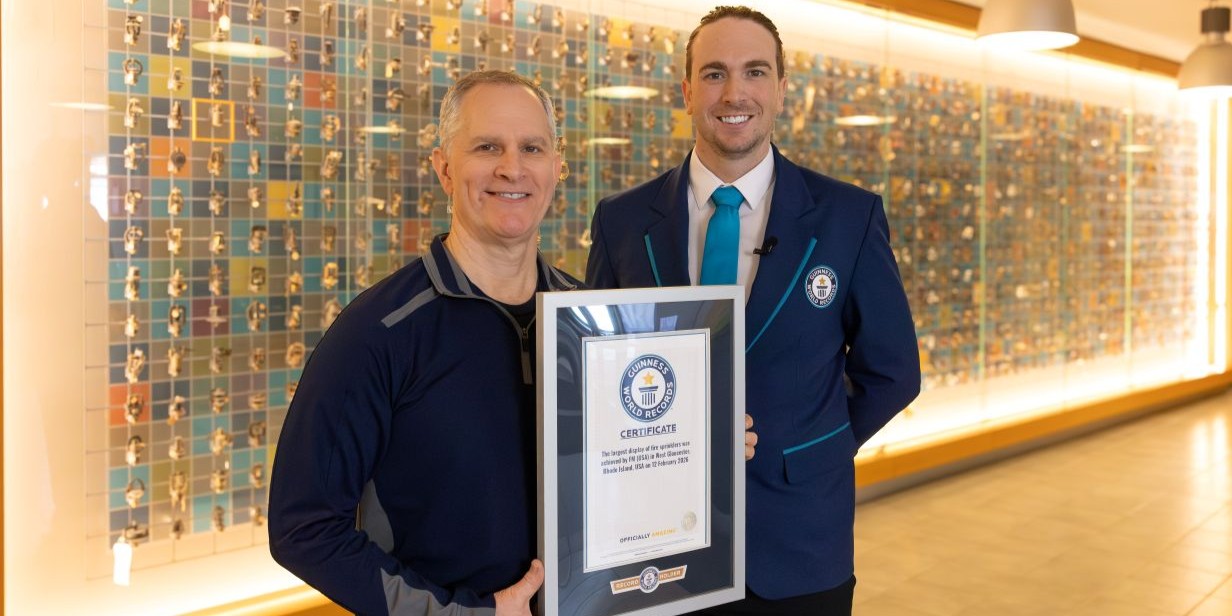
Thomas Bradford came prepared.
An adjudicator for Guinness World Records, he walked into the lobby of the FM Research Campus in West Glocester, Rhode Island, on a seasonably chilly day in February 2026 with a protocol, a certificate and, most importantly, a handheld counter that clicked each time he pressed it.
Bradford was there to count every single sprinkler displayed on the wall of the lobby. As FM engineers, researchers and the Rhode Island state fire marshal watched, Bradford clicked the handheld counter. And clicked. And clicked.
He clicked 1,007 times. And a new world record was set.
"You are officially amazing and the recipient of a brand-new Guinness World Records title," Bradford announced, handing a framed certificate to FM Research Campus Manager Ron Hinthorn. And with that, FM made it official: The largest display of fire sprinklers in the world belongs to the company that has spent nearly two centuries working to refine them.
Years in the making
The 1,007 sprinklers displayed on the wall of the FM Research Campus lobby form a timeline. Models span from the nascent devices of the 19th century to the precision-engineered sprinklers protecting data centers today, all mounted on a single wall to show the full arc of the technology. The display makes an otherwise abstract engineering achievement suddenly, unmistakably concrete.
The story begins with Zachariah Allen, born in 1795, a risk management visionary who founded the company that would eventually become FM. Allen believed most property loss was preventable, which became the foundation of FM's engineering philosophy.
Early automatic sprinklers were rudimentary by any measure, built on the straightforward concept that water on a fire, fast enough and in the right place, limits the damage before it spreads. FM's researchers spent decades testing and honing that premise.
In the 1950s, FM's research led to a breakthrough in sprinkler design, advancing the technology to discharge 100% of water downward and allowing sprinklers to capture fires earlier so they can protect buildings more effectively. Today FM holds several patents on sprinkler technology. The lobby wall captures all of it, from Allen's era to the present, in one compelling display.
Fire damage with vs. without sprinklers
Sprinklers have been around long enough that their effectiveness is well settled. According to the National Fire Protection Association, in 94% of structure fires reported between 2017 and 2021 in the United States where sprinkler systems were present, fire spread was confined to the object or room of origin. In properties with no automatic extinguishing system, that figure drops to 70%. Twenty-four percentage points separate a controlled incident from a catastrophic loss.
"Fire is the costliest and most dangerous risk to commercial property, and automatic sprinklers can be tremendously effective in mitigating it," said Christopher Wieczorek, Ph.D., staff vice president and senior engineering technical specialist at FM. "We celebrate the technology as part of a strategy that includes research, data analysis, practical guidelines and product-approval criteria. Zachariah Allen would be proud of this record and the legacy of protection and loss prevention that it represents."
Where research happens
The FM Research Campus spans 1,600 acres and is the world's largest center for advancing the science of property loss prevention. Four laboratories and a remote explosion hazard research area house more than 60 test apparatus running at any given time. Scientists and engineers work inside to simulate real commercial property hazards, such as fires, and validate the recommendations FM makes to clients operating some of the most complex and high-value facilities on earth.
"One of the exciting things is when we bring clients to the FM Research Campus," Wieczorek said. "Seeing them look at the display and get excited about the technology as they get a better understanding of how it works and how it protects their facilities."
Rhode Island State Fire Marshal Timothy McLaughlin attended the official ceremony and offered a plain-spoken assessment: "In my business, we're big proponents of sprinklers. It's part of our code. In this facility it's proven, and everywhere it's proven, that sprinklers prevent loss."
To learn more about FM's fire research history, listen to the Sound Policy podcast episode featuring FM Chief Science Officer Lou Gritzo, available on Spotify or Apple Podcasts.