
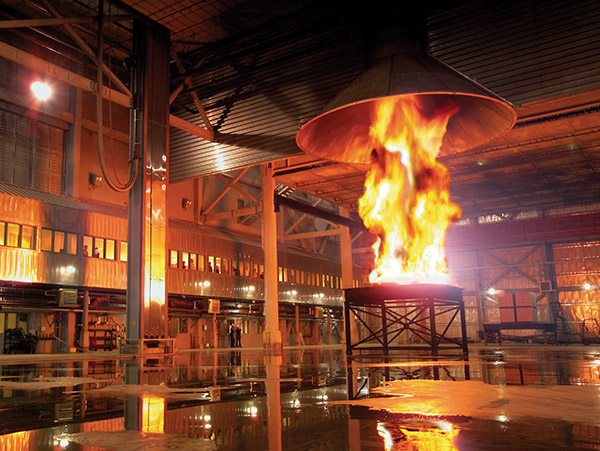
Los videos de las pruebas de incendio de FM están disponibles en línea
Al anticiparse a los riesgos e implementar soluciones innovadoras, puede fortalecer la resiliencia y la confiabilidad de las operaciones de sus centros de procesamiento de datos.


El mundo enfrenta hoy numerosos desafíos: nuevas tensiones geopolíticas, el cambio climático y tecnologías que impulsan la innovación, pero que también introducen nuevas amenazas.
Pero ¿qué ocurre con el riesgo más antiguo de todos? Los incendios siguen siendo la principal causa de siniestro para los asegurados de FM. ¿Por qué? ¿Qué nuevas tecnologías están incrementando este riesgo? ¿Y cuáles están ayudando a mitigarlo?
En este episodio de Sound Policy, conversamos con Lou Gritzo, director científico de FM, para analizar estas preguntas y entender cómo evoluciona el riesgo de incendio en un entorno cada vez más complejo.
Encuentre Sound Policy en Spotify, Apple Podcasts y YouTube.
A continuación, se incluye una transcripción generada automáticamente (en inglés).
Brian Amaral: Lou, welcome to the podcast. Thanks for being on.
Lou Gritzo: My pleasure.
Brian Amaral: First, can you introduce yourself? How long have you been at FM? What do you do at FM?
Lou Gritzo: I'm Lou Gritzo. I'm the Chief Science Officer at FM. I'm responsible for our technical strategy for managing emerging and underserved risks, and I've been at FM for almost 20 years now.
Brian Amaral: So we're talking about fire today. What's your background in fire?
Lou Gritzo: So I started doing research in fire science, after my graduate degree. I went to work for a national laboratory and at that time there were a lot of weapon systems being dismantled and they were being transported and there was concerns about what would happen if they got in a fire.
So that kind of started my trajectory in fire science and of course it's still incredibly important today.
Brian Amaral: Fire is the number one loss driver for FM right now. Do you think a lot of people know that? Is that something that might surprise people?
Lou Gritzo: I think that top of mind today is largely climate risk.
That's what companies are thinking about. When we look at emerging risk studies, that tends to pop to the top and that's because it's changing. And things that are changing are the ones that seem to get attention and justifiably so. And as important as climate risk is, fire continues to be that problem that can't quite be solved completely. And causes maybe some under the radar kinds of losses for companies because maybe we've just grown a little bit, used to it, to a certain extent.
Brian Amaral: Can't be solved – What's behind that? Why can't it be solved? What are some of the challenges there?
Lou Gritzo: We technically know how to put out fires. Fire sprinklers have been around for a long time. The challenge is that when those fires start, even with current technology, they still do a fair amount of damage, and sometimes that technology is not accepted. Maybe those protection systems aren't installed or not maintained correctly, and so we just continue to see these fires occur.
Not only some small ones that, are manageable, but some really big fires that rage out of control. Batteries really are kind of top of mind right now in addition to climate. There's been a lot of cases where batteries have been attributable as the source of a fire, because they go into thermal runaway. So I think that's kind of brought fire a little bit to the top of the radar screen now from being fairly low. But when we look at just the overall numbers and the gross loss for businesses, it's still fire.
Brian Amaral: FM did a survey recently on natural hazards and one of the questions we asked corporate insurance buyers and brokers about the risks being most regularly discussed at the board level.
Fire and explosion came in seventh of the risks that we asked about after reputational risk and before disease and pandemic. To put it bluntly, is, do they have it wrong? Should it be higher on that list?
Lou Gritzo: I'm not sure it should be higher, but it certainly shouldn't be off the list. Boards, justifiably so, are thinking about what's the issue of the day and what are the things that companies need to be thinking about for tomorrow.
I think what might have happened here is that we've just gotten a little bit to the point where there's too much acceptance of it. Fires still are fairly rare and boards are focused on, “okay, what are the things that we as a company need to be thinking about?” Not necessarily the things that have plagued us in the past or that we've always dealt with. They're more forward thinking, which is good to a certain extent, but the challenge is we miss those opportunities for companies to tackle the issues that they've always dealt with, but might not have to deal with them any longer if they would take a different approach.
Brian Amaral: It's interesting. FM's corporate history, going back to 1835, is the Manufacturer's Mutual Fire Insurance Company of Rhode Island back in 1835 when fire was the big risk for mill buildings. 2025, the statistics show that it still, even beyond the natural hazards, the boiler and machinery, the escaped liquids still continues to outpace those other ones.
What needs to happen to reduce the incidence of fire and how much damage they can cause?
Lou Gritzo: Two things need to happen. First, is that technology needs to be used to improve fire protection systems. It's been 150 years since the first industrial fire protection system was installed in a piano factory in New Haven, Connecticut.
Brian Amaral: 1874.
Lou Gritzo: In 1874, a gentleman, Parmelee, owned a piano manufacturer in New Haven, and he invented and actually patented a couple years prior to that, the first automatic fire sprinkler. And it works very similar to the fire sprinklers of today.
It has something that heats up and when it heats up, it opens up a hole in, in the device and, and water can come out. It wasn't really adopted very quickly. So the first fire sprinkler that went in an industrial building was not something that really just took off and was widely accepted. And reportedly the reasons for that is it was maybe a little expensive and it was complex and there wasn't, a whole lot of comfort around the reliability.
So fast forward to today. In 2017, FM published a public report on what we call the smart fire sprinkler system, where you use an array of sensors, multi-parameter sensors to avoid false alarms. An algorithm behind those sensors that finds fires when they're small, and then a control system to release a small amount of water to extinguish fires before they grow, rather than wait for them to activate a sprinkler on the ceiling or somewhere else.
The challenge is with adoption. Same things Henry Parmelee faced in 1874. It's expensive, it's complex. I'm concerned about the reliability. So even though we did a reliability study a few years later, showed that with correct maintenance and operations, it could be just as reliable as today's fire sprinkler system.
It still hasn't taken off. We have a couple of partner companies we're working with here at FM, but progress is slow. So first thing that has to happen to move the ball forward is technology, the use of technology. The second piece is monitoring the technology that comes out in industrial facilities and being able to get on top of that faster. And here's where we see the move towards more electric equipment, mass electrification, if you will. We're moving away from fossil fuels to more electrical systems. The prevalence of batteries in places that we've never seen them before. The demographic shifts of a lot of experienced people retiring, automated systems that take people out of buildings so the people can oftentimes be the first ones to see a fire when it's small.
Those are all things that challenge us to come up with new protection solutions faster and deal with this changing landscape.
Brian Amaral: You were mentioning batteries and electrification. We mentioned that fires are still the number one loss driver for FM. What sorts of fires? What is the big driver of those fires?
Lou Gritzo: The biggest ignition source in industrial fires have to do with the electrical system. It's switch gear, it's a box, it's a short somewhere, and that small electrical spark heats something up and causes a fire to grow. So as we look to increasingly complex automated systems, electrical systems to replace fossil fuel, heating, or industrial equipment, there's got to be a conscious decision to make sure that, first of all, those fires don't start. They're good quality systems, but maybe even more importantly, we use monitoring technology to see when that system is operating off normal, when maybe there's a fire that's incipient and start to tackle them early rather than wait for them to get hot and activate a ceiling sprinkler.
Brian Amaral: Speaking of technology, off gas detection, water mist systems, can you talk about those technologies, how they're emerging and might help combat this issue?
Lou Gritzo: Well, batteries have really placed fire safety at the forefront for a number of applications. Certainly renewable systems use battery energy storage to keep some of that energy to when it needs to be used.
Maybe it's generated at one time and used at a later time, and thermal runaway, when those batteries go into an off normal condition and start to heat up is really the big challenge to face relative to fire hazards and batteries.
When batteries start to go into thermal runaway, as they heat up, of course they get warmer, but that temperature produces some gases, some light gases from the battery itself. Those gases can be sensed. And using modern sensor technology, finding those gases is a signal of incipient thermal runaway, and being able to shut off that system as an effective use of addressing a fire before it starts. Preventing a fire from becoming significant.
The big challenge with batteries is they have a lot of energy. That's what batteries are good for. So other than trying to attack the battery fire before it starts, the only other solution is really just quench it and drop the temperature down as much as possible. Because you've already got the fuel and the oxygen there, which is why batteries are such a challenge.
Brian Amaral: We are recording this at our headquarters in Johnson, Rhode Island. We're a few miles away from the FM Research Campus in West Glocester, Rhode Island. What sort of work goes on at the fire lab there?
Lou Gritzo: The fire technology lab at the FM Research Campus is really focused on grounding the science that FM brings to fire protection in reality, It includes small, intermediate, and very large, up to the size of a small house, fire testing capabilities that allow FM to understand new hazards and probably most importantly, develop new loss prevention solutions and make sure that they work.
So grounding those kinds of solutions in reality and perhaps in some cases even more importantly, being able to show a real scale fire to a company that has that challenge and show how those solutions can be implemented to address that hazard is a core part of what the FM Research Campus here in Rhode Island does.
Brian Amaral: What's the most unusual thing that has been set on fire at the research campus while you were there? What's your most memorable test?
Lou Gritzo: visitors to the FM research campus, ask that question about what is the strangest thing you've ever tested? And it ranges for all the things that you can imagine in, commercial industrial properties.
We did some work for distilled spirits. This is the project that every researcher wanted to work on until they found out that there were no drinkable distilled spirits involved.
And a number of years ago, after one of the major storms, we had some surplus yachts. So we had the opportunity to do some fire testing on luxury yachts and find a great solution to protect those while they're being manufactured.
So really anything that is relevant for industry can be tested there. The challenge at the FM Research Campus is being able to develop the science behind it to minimize the number of full-scale tests we do. And so for that, in 2008, we started a significant computational fire modeling effort. FM took a very unique approach on this, a very strategic, long-term approach, which is consistent with our mutual ownership of making that model development, open source, open to government, our clients, academia, to contribute to the development of that tool. And in the time that has passed, it's become a viable solution for doing calculations of fire spread and fire protection that give us insight into fire phenomena that allow us to test smarter and do fewer tests, which allows us to solve more problems faster.
Brian Amaral: When you're bringing a client around the Research Campus and you're doing a large scale fire test, what are they telling you? What's going through their minds as they're seeing the large warehouse tests, for example, go up in flames?
Lou Gritzo: Last year, FM brought 3,000 visitors through our research campus to see what we do. The number one thing that we hear when they see a full-scale fire test is how fast that fire grew, how much heat was produced from it quickly. In a few moments, something that looks like just an ordinary storage of boxes in a warehouse becomes a wall of flame, and, and it really drives home the message that most of the time we're fortunate enough to where we're not experiencing fires, but when fires occur, they either fizzle out or they take off. There's very little in between.
Brian Amaral: For people who have been to the Research Campus, you may know that you are watching the fire from behind a glass partition, obviously, and you're seeing this big fire, but you can really feel the heat coming off that fire even from the test. Right. I mean, walk us through what are the senses that you're seeing and feeling and smelling even when you're at the research campus watching a large scale fire test.
Lou Gritzo: Large scale fire testing at the FM Research Campus is really focused on making sure that there's a safe experiment that is realistic, that provides us a solution or, or illustrates a solution to a client. Clients are in a visitor's gallery that is protected by heavy glass. They're in air conditioned space, so they don't smell the fire which is a good thing. But you certainly can feel the heat of the fire through the glass, even being on the order of 40, 50 feet away from the flame zone. And that's just simply the scale of industrial fires. They produce an incredible amount of heat, even at that distance.
And, and so the opportunity at the Research Campus is to make sure that reality is played out in a way that is, first of all, safe for our employees and protects our property, which is our job, but also provides solutions and an experience for clients that they understand those solutions. Nothing changes a company risk manager or even a CFO's mind about whether or not they should invest in some fire protection solution faster than seeing the consequences of an unprotected large scale fire.
Brian Amaral: What about fire risk keeps you up at night?
Lou Gritzo: The changing hazard of fire risk is the big problem.
Those are the things that I worry about missing. We know that businesses now have batteries where they didn't. We’re all when carrying these little batteries, which are potential ignition sources around with us all the time. Automated systems more tightly packed. Plastics, combustible materials and industrial facilities.
And on top of that, the future of water scarcity. Water's still the best way to put out a fire. And in many places that water's not available. If you pile on top of that, the changing climate, increased temperature and the drive to be more sustainable through electrification and electricity is the number one source of ignition for fires.
There's a lot of factors that add up to produce a very rapidly changing hazard and it becomes a foot race for the hazard assessment and the solutions to be in place in time before the fire hazard starts to outgrow or outscale the solution space. And, that's the challenge, is seeing those challenges as they evolve, understanding that when they go to the extreme case where a fire’s going to be out of control, where we can break that chain and do that research in time for the solutions to be in a client facility is the grand challenge that we face.
Brian Amaral: So when people think about insurance and fires, we've been talking a lot about electrical fires, warehouse fires, but it seems like a lot of people might think about wildfires as well, obviously been in the news lately. What role is climate change playing in the wildfires that we're seeing? And why is this a really high profile peril right now?
Lou Gritzo: Certainly a warmer climate has produced the potential for more severe wildfires, but it's not the climate alone. The policies in the United States and many places around the world has been to put out any kind of wildfires quickly as possible. And that's resulted in a significant accumulation of fuels, dead wood that's just ready to burn in the forests.
So on top of that, we have a warming climate, and if there's no moisture to be captured in that warm air, then it results in extended period of drought. Moisture content of the forest materials is the number one factor that causes fire intensity and to some extent fire spread, absent wind and other factors.
So the wildfire problem for businesses really faced I would say a cliff in 2017. That's when we saw major California fires. 2018 had the Camp fire, which basically decimated the town of Paradise, California. So at that point in time, fires went from fires in the forest that maybe affected some towns, but mostly mountain towns, to fires that would involve urban and suburban areas and spreading very quickly due to a lot of embers, made worse by the wind. All these things stack up to produce incredibly fast moving fires. Fires that move much faster than the wind blows and, that takes communities and businesses by surprise, and once structures start to get involved in fires, the heat release from a structure is about 10 times the heat release from any forested materials. So that makes it very difficult to extinguish those fires. On top of the challenges that we have with development and the accumulation of forest fuels, the buildup of economic value in areas that are fairly forested and we all like trees, has resulted in a lot more value at risk. So all these things together have made wildfire a risk that is more significant than it's ever been in the past, more difficult to deal with because they're big. In some cases they're year round. There's no longer a fire season. The California fires a 2025 happened in January. Not when you would think it's fire season. So all these things stack up to make wildfire a challenge.
Brian Amaral: What are some resilience strategies for wildfire?
Lou Gritzo: Probably the single best thing to prevent a structure from being engaged in a wildfire is non-combustible construction. Making sure that the building envelope doesn't have combustible components, especially those on the exterior of the building that prevents any embers or any kind of flames that are adjacent to the structure from catching the structure on fire.
Brian Amaral: Yeah. Can you give examples of what some of those materials are?
Lou Gritzo: Good examples of non-combustible materials in the exterior of a building are having fire rated shingles, a fire rated roof. Oftentimes embers will land on those roofs. Of course you have to keep them clean, keep all the pine needles or any kind of leaves that things off of them as well.
Siding that is not combustible. Different composite materials or concretious kind of siding materials. There are a lot of options for non-combustible construction other than just a basic boring cinder block. Brick and stucco if they don't have anything, flammable behind them or good options as well.
Brian Amaral: Does FM approvals do any of that testing to certify against wildfires?
Lou Gritzo: For commercial buildings, FM Approved wall panels are a great way to ensure that they're non-combustible construction on the outside and they're also tested and certified for wind relative to the wind zone of the building.
Brian Amaral: Have we gotten to the point where there are certain places where people shouldn't be building because of the risk of wildfire?
Lou Gritzo: I wouldn't go so far as to say there are some places where there should be no construction due to the wildfire hazard. The wildfire hazard can be managed with good land use planning and that land use planning includes open spaces, areas for fire protection areas with green space that will ensure that embers don't, get adjacent to a building and the correct construction type. Having plantings around the building that are low combustibility, certainly plants with high salt content, high moisture content. Very few oils are good options. So there are land use and design options for building in what otherwise would be a wildfire prone area. And also managing the forest materials in those areas becomes very important.
Adjacent areas often benefit significantly from what's called forest thinning, which is going in and, and trimming out some of that dead wood that's accumulated over the years, especially if the policy in that region has been to put fires out and not let them burn naturally. So the pieces of that puzzle can come together to result in a fairly resilient or robust protection against wildfires, of course. And then on top of that, there's that great emergency response plan you always need to have in case something happens.
Brian Amaral: For the other sorts of fires that we're talking about, the electrical fires, the sorts that are the main loss drivers, what are some resilience strategies for those ?
Lou Gritzo: Fires inside a building include a lot of different options for ensuring, first of all, that they don't start. Second, if they start, they don't spread. And third, if they start and they spread, you put 'em out. As quickly as possible. So the exact strategy depends on what you're doing in the building. Is it a manufacturing line that has certain oils and lubricants, ignitable liquids as we call them, whether it's a frozen food warehouse where there's, combustible items in boxes, Also, a lot of insulation materials that are involved in the construction. So really understanding the hazards, the construction hazards, the occupancy hazards, and then identifying the right prevention protection options are critical for businesses.
Brian Amaral: What are some of the technological advancements that are happening right now that excite you that might help address this issue?
Lou Gritzo: Technology presents the opportunity to really manage the fire problem effectively, and it starts with sensors that can identify when a fire's about to start.
Making those sensors connected to systems that allow the appropriate response given the operations. For example, a switch panel that's starting to overheat, you're not gonna just turn the power off all of a sudden. You have to have some operations to say what is appropriate, who's gonna do what, and what's my preventative measures there?
On top of that, the ability to find fires through different sensing technology, video sensing technology, heat temperature, and then be able to get the right kind of protection solution. Water is still the best solution for putting out fires, but it's not always appropriate. Get the right solution for that fire, when the fire's small.
So all fires start small. Explosions not so much, but all fires start small. So the idea is to sense it, and keep it from starting, and then put it out when it's small. And there's all kinds of sensing and extinguishment technologies that are really developed from a technical perspective. It's not the technology that's the barrier, it's the integration, the commercialization, and the innovation in getting those to overcome the 150 year old problem of cost, complexity and reliability.
Brian Amaral: Back at that piano factory,
Lou Gritzo: Back to the piano factory where their history repeats itself.
Brian Amaral: Speaking of technology, you’re one of the inventors on a patent. US 9805588b2, Wireless, Fire Protection, Valve Inspection and Monitoring systems. What's the story there?
Lou Gritzo: So the story behind that patent is, when we are reviewing losses within the research organization to see opportunities for us to ensure that our research was going to reduce those losses.
One of the things that really stuck out was this notion of improperly closed valves. Which means that there's a fire protection solution there and it's installed, it should work, but somebody somehow closed a valve and it's not going to allow the water to get to the fire. And that valve could have been closed because there's a maintenance, they needed to do something within that sprinkler system or within the area. It could be that somebody closed it by mistake, or it could be that the valve is just flat out broken.
So I was thinking about that one day and, and, and I was pulling out my badge to get into the building and I tapped it against the RFID card reader and I thought, Hmm. So I have good technology that this door knows it's me and knows I need in. Can we apply that to a fire protection valve to where we know it's open? And the right people know it's open? And the company doesn't have to send people around to go and check all those valves. They can use the same technology. So that's basically how that patent came about.
A solution to use technology to solve a problem that would reduce fire losses by greater than a factor of 10. So if those valves are closed, the average loss is on the order of three and a half million dollars. If those valves are open and the fire protection system works, then the losses are less than $300,000.
So what that patent did was allow companies then to come in, because we non exclusively royalty free license our intellectual property here at FM to try and encourage commercialization of that property. Allow a company to come in and put a product on the market and allow clients to use it to know their valves are open without having to send one of their people chasing down valves all over the facility, which in some cases can include hundreds of valves for a large industrial complex.
Brian Amaral: Is it in use now?
Lou Gritzo: Absolutely. There are FM Approved, wireless monitoring systems for those valves on the market right now.
Brian Amaral: But it is a non-exclusive, royalty free patent. So anybody can use this patent and take it and put it in their system.
Lou Gritzo: FM's goal through our research is to make solutions available to clients as quickly and cost effectively as possible. So the approach of non-exclusive royalty free licensing our technology is to try and encourage that adoption. FM Approvals group that will test and certify those products when they make it onto the market.
But our goal is to try and get as many tools in the toolbox if you will, for solutions to the age old fire problem.
Brian Amaral: Lou. Thanks for being on the show.
Lou Gritzo: My pleasure.
Al anticiparse a los riesgos e implementar soluciones innovadoras, puede fortalecer la resiliencia y la confiabilidad de las operaciones de sus centros de procesamiento de datos.

Los incendios forestales están siendo cada vez más difíciles de controlar, tanto por su impacto físico como por sus consecuencias financieras.

Una vez más, Pepperdine University demuestra un desempeño sobresaliente al enfrentar con éxito una prueba de incendio forestal.