
Hot, wet, dry and complicated: Australia’s 2026-27 summer climate preview for business
rom data centres in Western Sydney to mines in the Pilbara and manufacturing plants around Melbourne, another Australian summer will put buildings, infrastructure and business continuity to the test.


There is no single summer ahead of us, which is the first complication.
The Bureau of Meteorology (BoM) is confident about the heat. From November to January, temperatures are very likely to be above average across almost all of Australia. The rain is another matter. Parts of the west, centre and east should come out wetter than average, while Tasmania, small pockets of southern Victoria and much of the tropical far northern coastline lean drier.
Behind the forecast sits a strong El Niño that, by BoM’s reckoning, is still gathering strength and should peak around November to December as a very strong event. A positive Indian Ocean Dipole is expected to return to neutral in early summer. For a business, the climate pattern matters less than what happens when heat, rain and storms meet a building full of equipment, and across a country running from Hobart to Darwin, that happens in a dozen ways.
The long, warm night
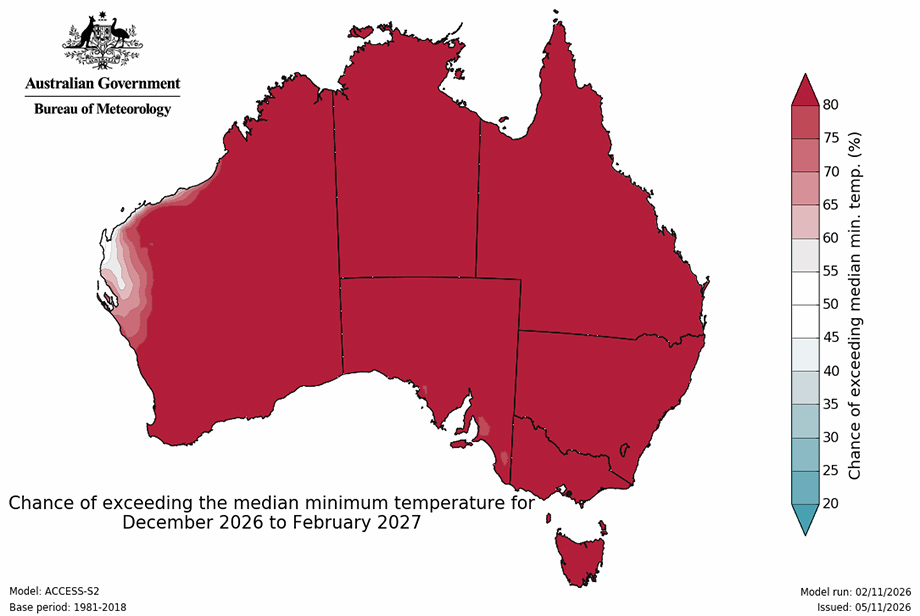
Take the days first. BoM puts the chance of unusually warm ones, meaning the warmest 20% of the 1981–2018 record, at over 50% across much of the country, and above 70% in parts of New South Wales, eastern Victoria and Tasmania. The nights carry the bigger number: over 80% for much of Australia, or more than four times the normal likelihood.
Warm nights are the quiet problem for commercial property. A distribution centre at Eastern Creek or a plant in Dandenong never really recovers when the temperature refuses to drop: cooling systems run longer, refrigeration stays under load and electrical equipment has no chance to shed its heat. Data centres feel it most. The Australian Energy Market Operator (AEMO) estimates they used about 3% of grid electricity consumption across the National Electricity Market in 2025-26, roughly two-thirds of it in New South Wales. Maintenance and redundancy stop being line items and start being the business.
El Niño, with caveats
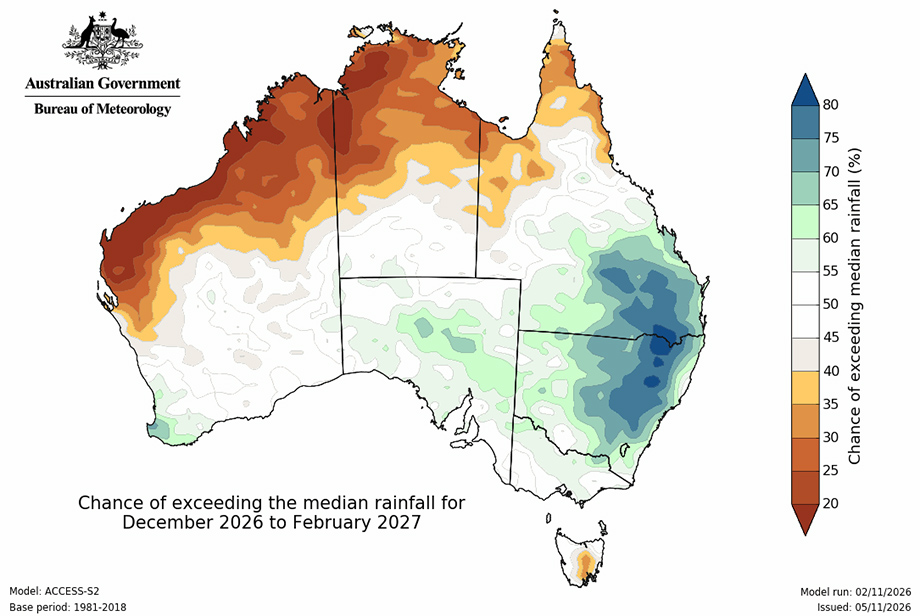
El Niño has become Australian shorthand for hot and dry, and BoM is quick to point out that it is not that simple. A strong signal in the tropical Pacific does not necessarily mean strong effects here, since it is only one of several influences on our rainfall and temperature. The outlook gives a 60% to greater than 80% chance of above-average rainfall across most of the south-west and central southern Australia, central and southern Queensland and northern New South Wales, with the wet signal stronger in the west early on and building in the east through December.
Heavy rain is not only a question of whether water reaches the front door. Flooding can cut the roads that serve a warehouse and swamp drainage long before anything enters the building. A food processor near Toowoomba faces a very different exposure from a CBD tower, but water tends to find the weakest part of a site either way. Drains, gutters, roofs and pumps deserve a look before summer arrives.
The north keeps its own counsel
Up north, the usual season of building humidity, storms and showers is getting under way, yet BoM gives a 60% to 80% chance of below-average rainfall across much of the tropical far northern coastline, as it does for Tasmania and small parts of southern Victoria. A drier three-month average does not rule out one very wet Tuesday, and the cyclone season opens in November.
Cool under load
Electricity is where heat and business risk meet most plainly. AEMO’s latest outlook does not forecast a reliability gap in the National Electricity Market before 2030-31, even on its more conservative assessment, so this is not a story about the lights going out. It is about a very hot afternoon from Penrith to Parramatta, when home air-conditioning and commercial cooling load climb together.
The sensible question for any business is not whether it has backup power but what that power actually carries, and for how long. For a data centre, losing cooling becomes an emergency quickly. A generator idling behind the building is comforting. One that has been tested, maintained and written into a continuity plan people have actually rehearsed is worth a great deal more.
Warm seas, wet roofs
The water offshore is part of this. In BoM’s analysis for the week ending 25 October, waters around much of Australia’s west, south and south-east ran up to 3°C above average, with further warming forecast, particularly to the north and in the Coral Sea. Swimmers at Bondi and Cottesloe will notice, but so should anyone with a large roof: BoM says warmer water can enhance the moisture and energy that fuel storms, raising the potential for high-intensity rainfall. A cloudburst can turn one blocked gutter into an expensive interruption.
Fire doesn’t read the forecast
A wetter outlook in some regions is no substitute for bushfire planning. AFAC’s spring outlook cautions that fires can still occur where the outlook is normal. Heat, wind, vegetation and local fuel all shape how a fire behaves, and anyone with premises in the Blue Mountains, the Adelaide Hills or the Perth Hills knows how quickly that can turn. Clear vegetation around buildings, seal up gaps to reduce the risk of embers entering buildings, protect[HM1.1] critical equipment outside, and assume that roads, power or communications may be cut even when the property itself is untouched.
Before the heat arrives
If there is a lesson in the 2026-27 outlook, it is that an average is a poor thing to plan around. Plan for the property in front of you.
Work out where the water will go and which equipment resents the heat, and find out what actually happens when the power stops. Then test those assumptions before the thermometer reaches 40°C or a storm shows up on the radar.
The forecast describes the summer Australia is likely to get. The work of risk management is done before it arrives.
Sources: Bureau of Meteorology, long-range forecast and climate outlook for November to January (issued 29 October 2026); AEMO, 2026 Electricity Statement of Opportunities and 2026 ESOO Data Centre forecasting overview (August 2026); AFAC, Seasonal Bushfire Outlook Spring 2026 (August 2026).