
In 2026, Asia-Pacific has been building for an AI future. Someone still has to keep the lights on.



At the other end is a building full of equipment, drawing electricity and producing heat. Across Asia-Pacific, the rush to build more has caught the attention of people who once left the details to IT. They want to know where the land, water and power will come from.
FM draws on engineering research and loss experience to assess those questions. For example, its Property Loss Prevention Data Sheet 5-32 examines electrical redundancy, cooling and fire protection together. A facility can have enough power on paper and still be vulnerable to an interruption.
A very big building project
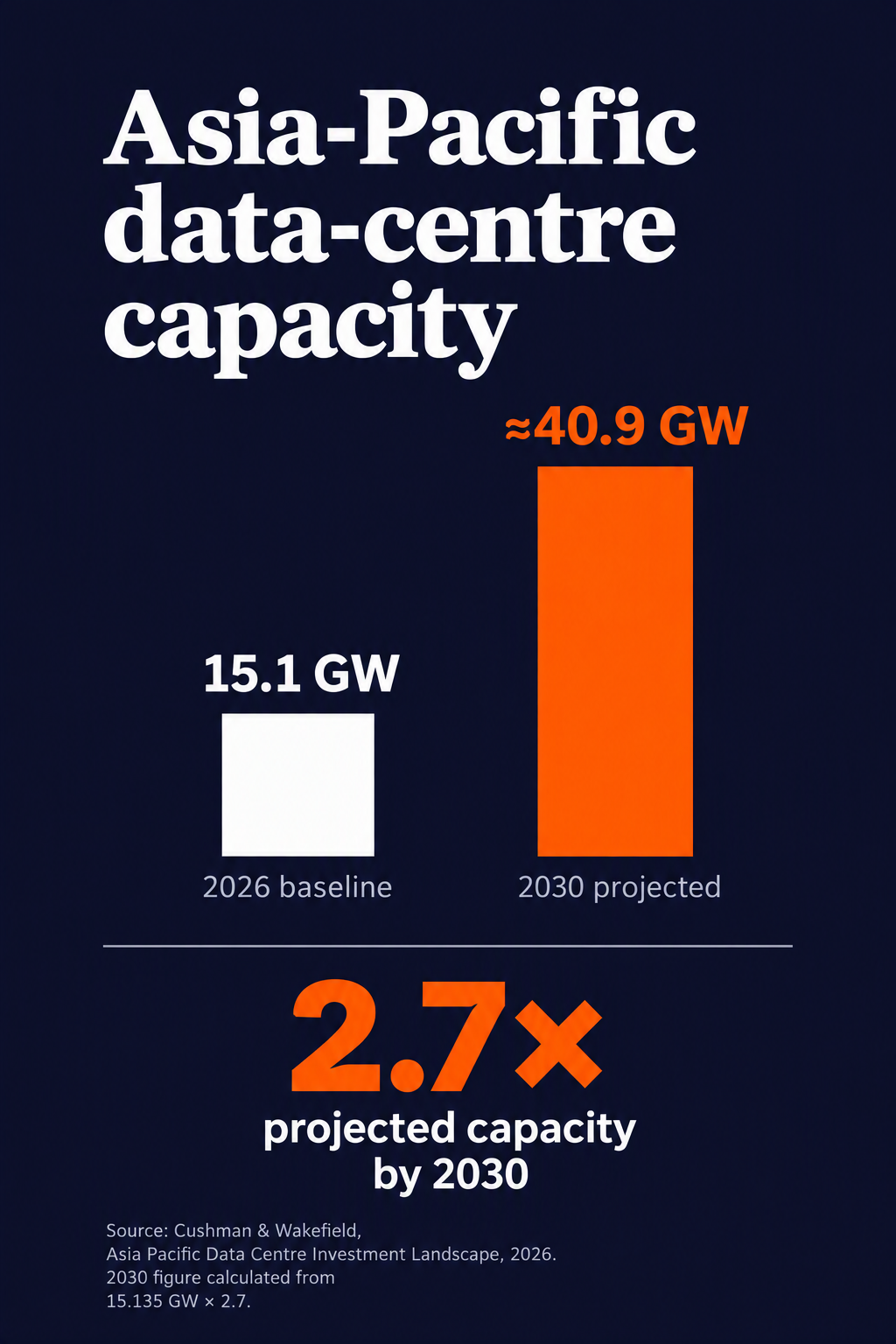
Asia-Pacific’s data centre development pipeline reached 26.5 GW in the first half of 2026, up 7.1 GW in six months. Of that, 21.7 GW remained at the planning stage and 4.8 GW was under construction. Roughly 1.4 GW came online, yet regional colocation vacancy fell as customers absorbed the space.
All that computing needs feeding. The region’s data centre electricity consumption almost doubled between 2020 and 2024 and is expected to triple again over the next few years, driven by AI, cloud migration and digitalisation.
A delayed grid connection can leave a completed facility accumulating costs without revenue. Once it opens, the concern shifts to interruptions: what could stop working, and how long might repairs take?
Singapore & Malaysia: Across the causeway
Start in Singapore, where finding room for another large building is no small undertaking. Its connectivity attracts data centres, but expansion must account for land, electricity and cooling in tropical heat. The Green Data Centre Roadmap aims for at least 300 MW of additional near-term capacity, with further growth tied to green-energy deployment.
Across the Johor Strait, the landscape opens up. Around Kulai and Sedenak, rubber and oil palm country now hosts hyperscale campuses. Johor accounted for 602 MW of Malaysia’s 1,039 MW under construction in the first half of 2026, Southeast Asia’s largest construction total. Calling it Singapore’s overflow market leaves rather a lot out.
Farther north, Cyberjaya and the Klang Valley serve established enterprise and cloud demand. Water and electricity remain constraints; in Johor, operators are exploring reclaimed water for cooling.
Heavy rain matters as much as heat. Where does runoff go when drainage is overwhelmed? Could water reach electrical equipment or delivery roads? The answers depend on the particular site, whichever side of the boundary it occupies.
Hong Kong: Behind the skyline
Hong Kong’s digital infrastructure takes you beyond the harbour skyline to Kwai Chung and Tseung Kwan O. Financial institutions, hyperscalers and mainland technology companies drive demand, while space and planning constrain expansion. Sandy Ridge, near Lo Wu, is set to add future capacity through the Northern Metropolis data facility development.
Here, a typhoon signal is part of the working vocabulary. Wind-driven rain, exposed cooling equipment and drainage need attention, as does access for staff and replacement parts. A building may keep operating while the streets around it become difficult to navigate.
South Korea: Beyond the capital
Seoul’s pull extends into Gyeonggi and Incheon, where customers and connectivity draw developers to the wider capital region. Spare colocation capacity is scarce: Seoul’s vacancy tightened to 1.1% in the first half of 2026. Securing enough electricity is harder.
Developers are considering regional locations, particularly for AI training that can tolerate distance from users. Services needing near-instant responses have stronger reasons to stay close. Korea’s summer rainy season, jangma (장마), also demands attention to drainage and flood protection. Moving beyond Seoul calls for a fresh assessment of utilities and access routes, too.
India: A different monsoon
India needs more than one stop. Mumbai accounted for 52% of operational stock at the end of the first half of 2026, with expansion reaching Navi Mumbai. Submarine cables underpin Mumbai and Chennai’s appeal; Bengaluru and Hyderabad have their own technology ecosystems. CBRE reports investment spreading as operators weigh power, water, land and connectivity.
Even the monsoon follows a different calendar. Mumbai prepares for the southwest monsoon; Chennai’s northeast monsoon brings rain from October to December. That changes when flood protection and emergency arrangements must be ready. Heat and water availability matter between the rains, particularly for cooling.
FM’s Mumbai reinsurance sales office and Bengaluru global capability centre bring commercial, research, analytics and engineering capabilities into the country. Geography matters to that work: a flood assessment for coastal Chennai cannot simply be carried over to Hyderabad.
Australia: Room on the map
Finish in Australia, where space looks plentiful on a map. Useful parcels still need power, fibre and cooling. At 31 March 2026, 162 operational data centres provided 1.4 GW, with 90 projects in the pipeline. Capacity is forecast to reach 3.2 GW by 2030, with much activity in New South Wales and Victoria.
In Sydney, head west to Eastern Creek, Huntingwood and Erskine Park, away from the harbour postcard. Anyone crossing the city on a summer afternoon knows the temperature difference. Cooling design needs to account for it; a coastal reading will not describe conditions inland.
Across Asia-Pacific, the rush to build more has caught the attention of people who once left the details to IT. They want to know where the land, water and power will come from.
Melbourne remains another major centre. Elsewhere, prospective sites need scrutiny for flood, heat, storm and, where relevant, bushfire exposure, including surrounding roads and utilities. FM’s regional teams must account for differences within cities as well as between countries.
Not in the launch video
Nobody attends an AI launch to hear about switchgear. FM’s engineering guidance gets into precisely those details. Cooling must protect server chips through the transition from primary to backup power. Getting the generators running is only part of the answer.
Denser computing produces more heat. Liquid cooling helps, but brings fluid close to sensitive equipment. FM recommends arranging it so a leak can be isolated without compromising other cooling supplies. A server upgrade can therefore require changes well beyond the rack.
Fire deserves attention alongside power. In the loss-history study reported in FM’s Data Sheet 5-32, fire accounted for 42.3% of data centre loss cost but 10.9% of incidents. Those are FM’s losses, not an industry-wide outage measure. Battery arrangements, construction materials and fire protection matter even when fires are comparatively infrequent.
Before signing off
Cushman & Wakefield identifies electricity availability as the industry’s primary bottleneck. A well-connected site near customers may still wait a long time for power. That deserves an early look, before an investment is approved.
FM’s approach is to examine how a failure could spread. Could one flood disable both primary and backup equipment? Would cooling survive an electrical interruption? Those questions belong in design reviews, while there is still scope to move equipment—or choose another site.
Most of us will keep uploading files without thinking about the building at the other end. Fair enough. The people designing, funding and operating it need to consider what happens on the day something stops working.