
Australia ranks as one of the most resilient countries globally as it rebounds from COVID-19


After a year of supply chain disruption, political tensions and growing climate worries, resilience has become a prized commodity for business leaders and it’s more prevalent in some places than others. Australia is one such country, ranking 14th overall out of 130 countries and territories in the newly released 2021 FM Global Resilience Index, the definitive ranking of nations by the resilience of their business environments.
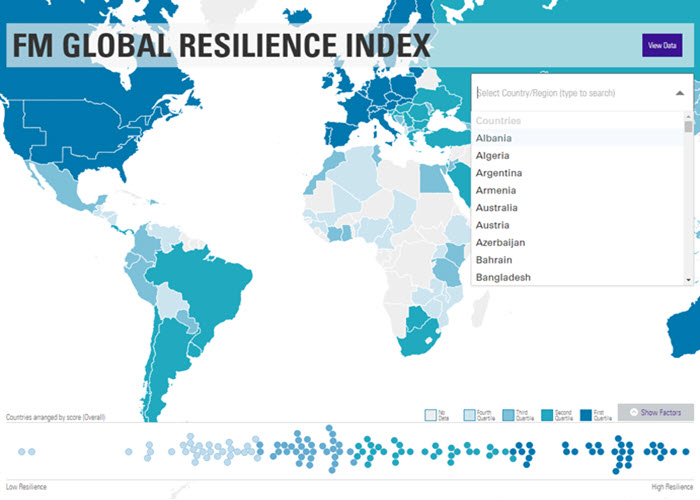
Produced by FM Global, one of the world’s largest commercial property insurers, the Resilience Index provides a composite picture of 12 objective measures reflecting each country or territory’s economic, risk quality and supply chain conditions. The resource helps senior executives create, evaluate and manage resilient multinational businesses by providing additional datapoints for consideration about site selection, partnerships and geographic markets.
Australia’s overall rank is due in part to its strong economic productivity (ranked 20) and low political risk (ranked 10), two key drivers of resilience that, along with other measures in the index, may foreshadow the vigour of the country’s rebound from COVID-19.
Lynette Schultheis, operations manager, FM Global Australia, says, “The pandemic brought many businesses to a standstill and caused significant business disruption and interruption. While we are well on our way to economic recovery in Australia, the events from last year brought into sharp relief that resilience must be embedded into all facets of a business so that it provides the ability to resist, rebound from or operate through adverse circumstances from lockdowns to climate-related and supply-chain disruptions.”
Climate risk and resilience in the global supply chain
Australia’s overall rank in the Index was held back due to its natural hazard exposure (ranked 49) which sits in the middle of the second quartile. This measure represents the percentage of a country’s economic activity that is exposed to at least one natural hazard such as wind, flood or earthquake.
The country’s strong natural hazard risk quality (ranked 16) reflects the quality and enforcement of the country’s building codes with respect to natural hazard resistant design, as well as the level of natural hazard risk improvement achieved. This measure is critically important for businesses with operations located in regions affected by natural hazards such as cyclones, floods and bushfires.
Where natural hazard risk quality may be of particular concern is for the many local businesses who have supply chains that extend into neighbouring countries across the Asia Pacific – many of which are exposed to natural hazards and the changing climate. Popular trading partners with notable room for improvement, in regard to their natural hazard risk quality, include Hong Kong (ranked 41), Taiwan (ranked 50), Malaysia (ranked 57), Indonesia (ranked 61), Thailand (ranked 62), India (ranked 67), Bangladesh (ranked 68) and Vietnam (ranked 130).
Australia’s largest trading partner, China (which is subdivided into three ranked regions because its geographical spread includes disparate exposures to natural hazards such as wind, flood and earthquake), ranked 91 across each region for its natural hazard risk quality.
“As many companies extend their supply chains across the region in the pursuit of reduced costs and improved competitiveness, they must also take into account the natural hazard exposure and risk of where their key suppliers are located. For example, Thailand experienced significant rainfall and flooding earlier this year across much of the southern region of the country which brought many businesses to a standstill. The impact was not only felt across the country but for those businesses who operated extended supply chains in the region. It’s essential that businesses take into consideration all of the potential risk factors involved with its business partners and country-level resilience is a critical part of that,” Schultheis adds.
Top 3, bottom 3 countries
Top-ranked Denmark is known for its quality of life, education, health care and income equality. In this year’s Index, it benefits from higher resilience rankings than last year in the measures for economic productivity, fire risk quality and oil intensity (signifying increased vulnerability to oil shock).
The Scandinavian nation’s rise bumps Norway into the number two spot, which previously held the top position in the Index in recent years.
Luxembourg rounds out the top three countries in overall business resilience, with Western Europe taking nine of the top 10 places. The Central United States is the lone exception, occupying ninth place as it did last year.
Iran for the first time entered the bottom three ranks with a 14-place drop in productivity and a 7-place drop in political risk rank. Venezuela, second to last, and Haiti, last, round out the bottom three countries.